.jpg)
What Does Your Child Learn in Kindergarten Curriculum?
- Aria Dana

- Nov 22, 2025
- 4 min read
Updated: Nov 26, 2025
Kindergarten curricula are designed to support children’s holistic development across academic, social, and creative domains.
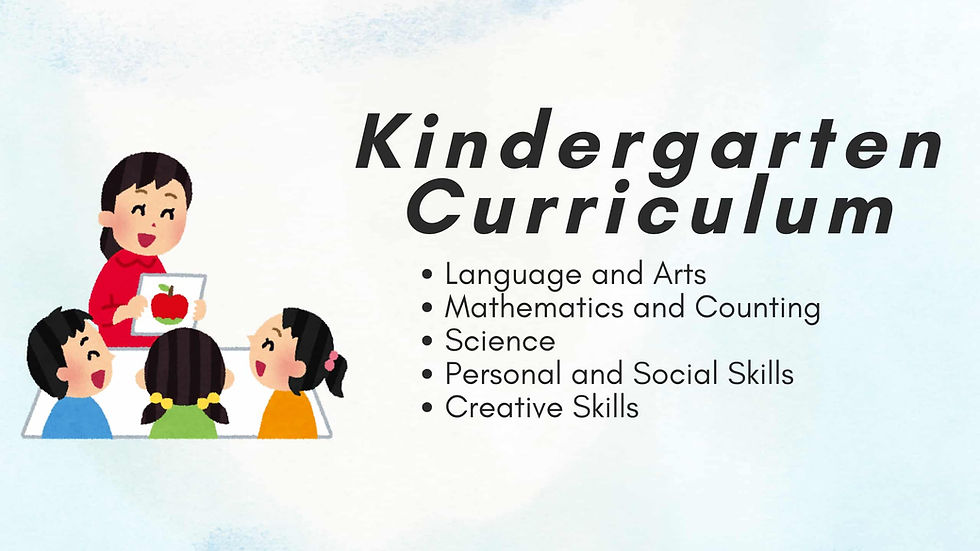
Table of Contents
Language and Arts
Kindergarten lays the groundwork for literacy by focusing on letter recognition, phonemic awareness, and the connection between letters and sounds. Children learn to identify and write all letters, associate them with their sounds, and begin reading simple words and sentences.
Activities such as rhyming, storytelling, and interactive speaking exercises nurture early reading skills and oral language development. Writing is introduced through drawing, tracing, and composing simple sentences about daily experiences, often using crayons and pencils to build fine motor skills and self-expression [4, 9, 10].
Tools you can use:
Alphabet Flashcards- letter recognition
Alphabet Puzzles - letter recognition
Letter Magnets - letter recognition
Phonics Flashcards - phonemic awareness
Phonics Puzzles - phonemic awareness
Phonics Games - turns phonics practice into engaging play
Rhyming books - early reading skills and oral language development
Sight Word Flashcards - recognize common words
Sight Words Workbooks - early reading skills
Wooden Alphabet Blocks - letter recognition
Mathematics and Counting
Children are introduced to basic numeracy, including identifying, writing, and counting numbers—often up to 30 or beyond. They learn foundational concepts in addition and subtraction, as well as early exposure to operations, algebraic thinking, measurement, and geometry.
Intentional teaching practices, such as group activities and hands-on interventions, help children develop skills in counting, shape recognition, comparison, and spatial awareness. Adaptive and game-based learning tools can further personalize instruction and support mastery of both basic and advanced math skills [1, 4, 6, 14].
Science
Kindergarten science education leverages children’s natural curiosity to explore topics like plants, animals, body systems, weather, and life cycles. Lessons often integrate observation, classification, and hands-on experiments, fostering cognitive skills and ecological literacy.
Early exposure to science is linked to improved motivation, vocabulary, and foundational understanding of the natural world. Integrated curricula that combine science and literacy can enhance comprehension and engagement [2, 10, 11, 13].
Tools you can use:
Personal and Social Skills
Social-emotional learning (SEL) is a core component, with curricula designed to build positive attitudes, self-awareness, critical thinking, and healthy habits. Activities promote collaboration, responsibility, and emotional expression through play-based and teacher-facilitated interactions.
SEL interventions have been shown to improve self-regulation, social competence, and behavioral adjustment, especially for children at risk for emotional or behavioral difficulties [3, 5, 7, 8].
Creative Skills
Creativity is nurtured through opportunities for drawing, painting, building, and imaginative play. Educational settings that use learning centers or “educational corners” have been found to significantly enhance creative thinking and problem-solving abilities.
Activities such as puzzles, block building, and arts and crafts encourage exploration and innovation, supporting both cognitive and emotional development [8, 12].
Tools you can use:
Wooden Puzzle Kits - imaginative play
Magnetic Building Blocks - exploration, creativity, and hands-on learning
Key Learning Domains in Kindergarten
Domain | Key Skills Developed |
Language & Arts | Letter/sound recognition, reading, writing, oral language, self-expression |
Mathematics | Counting, number writing, addition/subtraction, shapes, measurement, spatial skills |
Science | Observation, classification, life cycles, environment, inquiry skills |
Social-Emotional | Self-regulation, collaboration, responsibility, emotional expression |
Creativity | Drawing, building, imaginative play, problem-solving |
Table 1. Summary of core learning domains and skills in kindergarten curricula.
A quality kindergarten curriculum is intentionally structured to foster academic, social, and creative growth, preparing children for lifelong learning and success.
References
Bang, H., Li, L., & Flynn, K. (2022). Efficacy of an Adaptive Game-Based Math Learning App to Support Personalized Learning and Improve Early Elementary School Students’ Learning. Early Childhood Education Journal, 51, 717-732. https://doi.org/10.1007/s10643-022-01332-3.
Chen, Y., Wu, H., & Hsin, C. (2022). Science teaching in kindergartens: factors associated with teachers’ self-efficacy and outcome expectations for integrating science into teaching. International Journal of Science Education, 44, 1045 - 1066. https://doi.org/10.1080/09500693.2022.2062800.
Cipriano, C., Strambler, M., Naples, L., Ha, C., Kirk, M., Wood, M., Sehgal, K., Zieher, A., Eveleigh, A., McCarthy, M., Funaro, M., Ponnock, A., Chow, J., & Durlak, J. (2023). The state of evidence for social and emotional learning: A contemporary meta-analysis of universal school-based SEL interventions.. Child development. https://doi.org/10.1111/cdev.13968.
Cohen-Vogel, L., Little, M., Jang, W., Burchinal, M., & Bratsch-Hines, M. (2021). A Missed Opportunity? Instructional Content Redundancy in Pre-K and Kindergarten. AERA Open, 7. https://doi.org/10.1177/23328584211006163.
Daunic, A., Corbett, N., Smith, S., Algina, J., Poling, D., Worth, M., Boss, D., Crews, E., & Vezzoli, J. (2021). Efficacy of the social-emotional learning foundations curriculum for kindergarten and first grade students at risk for emotional and behavioral disorders.. Journal of school psychology, 86, 78-99 . https://doi.org/10.1016/j.jsp.2021.03.004.
Fayol, M., Darnon, C., Claracq, I., & Jury, M. (2025). When bears are bearing number acquisition: An early mathematical intervention for kindergarten children. European Journal of Psychology of Education. https://doi.org/10.1007/s10212-024-00933-3.
Lam, C., Li, X., & Chung, K. (2024). Improving Chinese children's socioemotional competence, behavioral adjustment, and pre-academic skills: Impacts of the 3Es Program. Early Childhood Research Quarterly. https://doi.org/10.1016/j.ecresq.2024.03.002.
Larsen, N., Pyle, A., Danniels, E., Marzouca, M., & Nazeem, R. (2023). Kindergarten teachers’ facilitation of social and emotional learning in classroom play contexts. Education Inquiry, 16, 195 - 216. https://doi.org/10.1080/20004508.2023.2192900.
McCormick, M., Weiland, C., Hsueh, J., Pralica, M., Weissman, A., Moffett, L., Snow, C., & Sachs, J. (2021). Is Skill Type the Key to the PreK Fadeout Puzzle? Differential Associations Between Enrollment in PreK and Constrained and Unconstrained Skills Across Kindergarten.. Child development. https://doi.org/10.1111/cdev.13520.
Gray, A., Sirinides, P., Fink, R., & Bowden, A. (2021). Integrating Literacy and Science Instruction in Kindergarten: Results From the Efficacy Study of Zoology One. Journal of Research on Educational Effectiveness, 15, 1 - 27. https://doi.org/10.1080/19345747.2021.1938313.
Poje, M., Marinić, I., Stanisavljević, A., & Dika, I. (2024). Environmental Education on Sustainable Principles in Kindergartens—A Foundation or an Option?. Sustainability. https://doi.org/10.3390/su16072707.
Sarayrah, A., Almraiyh, M., & Soub, T. (2025). The Effectiveness of Using Educational Pillars in Kindergartens and their Impact on Developing Creative Activities among Kindergarten Children in Raising the Marka Brigade. Journal of Posthumanism. https://doi.org/10.63332/joph.v5i5.1319.
Speldewinde, C., Guarrella, C., & Campbell, C. (2024). Listening to children in nature: emergent curriculum in science teaching and learning in bush kinders. International Journal of Science Education. https://doi.org/10.1080/09500693.2024.2365459.
Yang, W., Luo, H., & Zeng, Y. (2022). A video-based approach to investigating intentional teaching of mathematics in Chinese kindergartens. Teaching and Teacher Education. https://doi.org/10.1016/j.tate.2022.103716.


Comments