.jpg)
Mathematics Kits: Building Logic, Numbers, and Problem-Solving Skills
- Aria Dana

- Oct 25, 2025
- 4 min read
STEM Kit: Science | Technology | Engineering | Mathematics
Explore math kits that build logic, number sense, and problem-solving through fun, hands-on learning.
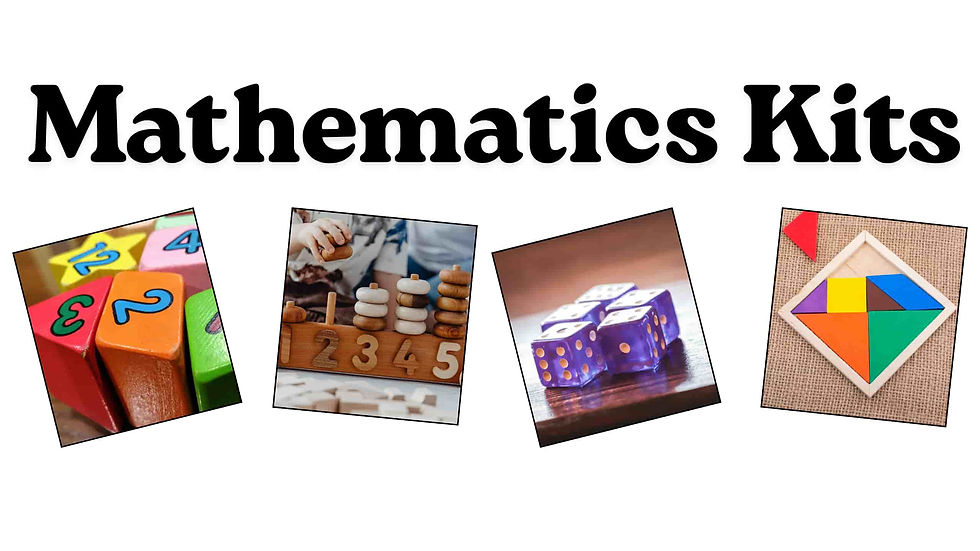
Table of Contents
What are Mathematics Kits?
Mathematics kits are structured sets of hands-on, often interactive, resources—physical or digital—designed to help students grasp mathematical concepts through direct experience, observation, reasoning, and application. These kits transform abstract mathematical ideas into tangible, visual, and engaging activities, fostering deeper understanding, curiosity, and confidence in learners.
Cognitive, Emotional, and Social Benefits
Mathematics kits offer more than academic gains—they support holistic development:
Benefit Area | Description |
Cognitive Health | Enhance memory, attention, reasoning, and problem-solving through active engagement [5, 7, 9, 10] |
Math Anxiety Reduction | Playful, hands-on activities lower stress and build positive attitudes toward math [6, 7, 11, 13] |
Emotional Regulation | Sorting, patterning, and logic games promote calm, focus, and patience [6, 9, 13] |
Mindfulness and Focus | Manipulatives require present-moment attention, similar to mindfulness practices [9] |
Social Well-Being | Collaborative activities foster teamwork, communication, and peer connection [1, 3, 4, 8] |
Table 1. Summary of cognitive, emotional, and social benefits of mathematics kits.
Educational Value of Mathematics Kits
Mathematics kits make learning practical, visual, and meaningful by:
Strengthening logical and analytical thinking [2, 7, 12].
Building confidence through interactive exploration [7, 10, 11].
Demonstrating real-world applications of math [4, 12].
Developing resilience and focus through hands-on practice [3, 8, 9].
Features and Types of Mathematics Kits
Mathematics kits can be categorized by the mathematical domains they target, each supporting specific cognitive and practical skills:
Arithmetic & Number Skills Kits
Focus: Foundational operations (addition, subtraction, multiplication, division), number sense, and computation.
Activities: Counting objects, arithmetic games, and fraction puzzles.
Benefits: Build core numerical literacy and reinforce basic operations through tactile and game-based learning, which is important for higher-level mathematics and everyday problem-solving [7, 11].
Example: Fraction puzzle kits help students visualize and manipulate part-whole relationships, making fractions more intuitive.
Geometry & Spatial Reasoning Kits
Focus: Shapes, measurement, spatial visualization, and problem-solving.
Activities: Tangrams, 3D model construction, angle measurement.
Benefits: Develop spatial logic, pattern recognition, and measurement skills, which are crucial for fields like art, architecture, and engineering [4, 12].
Example: Tangram sets and geoboards enhance creativity and spatial reasoning while reinforcing geometric concepts.
Statistics & Probability Kits
Focus: Data analysis, probability, and pattern recognition.
Activities: Dice games, surveys, graphing, and probability experiments.
Benefits: Make abstract data concepts interactive and visual, teaching students to collect, analyze, and interpret data, and understand uncertainty [4, 7].
Example: Dice-rolling activities teach probability, fairness, and prediction in a hands-on way.
By turning numbers and symbols into lived experiences, mathematics kits foster lifelong appreciation and competence in mathematics, supporting both academic achievement and overall well-being.
References
Bringula, R., & Atienza, F. (2022). Mobile computer-supported collaborative learning for mathematics: A scoping review. Education and Information Technologies, 28, 4893 - 4918. https://doi.org/10.1007/s10639-022-11395-9.
Canonigo, A. (2024). Levering AI to enhance students' conceptual understanding and confidence in mathematics. J. Comput. Assist. Learn., 40, 3215-3229. https://doi.org/10.1111/jcal.13065.
Cevikbas, M., & Kaiser, G. (2021). Student Engagement in a Flipped Secondary Mathematics Classroom. International Journal of Science and Mathematics Education, 20, 1455 - 1480. https://doi.org/10.1007/s10763-021-10213-x.
Cirneanu, A., & Moldoveanu, C. (2024). Use of Digital Technology in Integrated Mathematics Education. Applied System Innovation. https://doi.org/10.3390/asi7040066.
Güler, M., Bütüner, S., Danisman, S., & Gürsoy, K. (2021). A meta-analysis of the impact of mobile learning on mathematics achievement. Education and Information Technologies, 27, 1725 - 1745. https://doi.org/10.1007/s10639-021-10640-x.
Hanin, V., Colognesi, S., & Van Nieuwenhoven, C. (2020). From perceived competence to emotion regulation: assessment of the effectiveness of an intervention among upper elementary students. European Journal of Psychology of Education, 36, 287 - 317. https://doi.org/10.1007/s10212-020-00481-6.
Hussein, M., Ow, S., Elaish, M., & Jensen, E. (2021). Digital game-based learning in K-12 mathematics education: a systematic literature review. Education and Information Technologies, 27, 2859 - 2891. https://doi.org/10.1007/s10639-021-10721-x.
Joshi, D., Adhikari, K., Khanal, B., Khadka, J., & Belbase, S. (2022). Behavioral, cognitive, emotional and social engagement in mathematics learning during COVID-19 pandemic. PLOS ONE, 17. https://doi.org/10.1371/journal.pone.0278052.
Magistro, D., Cooper, S., Carlevaro, F., Marchetti, I., Magno, F., Bardaglio, G., & Musella, G. (2022). Two years of physically active mathematics lessons enhance cognitive function and gross motor skills in primary school children.. Psychology of Sport and Exercise. https://doi.org/10.1016/j.psychsport.2022.102254.
Pradana, L., Sholikhah, O., Maharani, S., & Kholid, M. (2020). Virtual Mathematics Kits (VMK): Connecting Digital Media to Mathematical Literacy. Int. J. Emerg. Technol. Learn., 15, 234-241. https://doi.org/10.3991/ijet.v15i03.11674.
Pellegrini, M., Lake, C., Neitzel, A., & Slavin, R. (2021). Effective Programs in Elementary Mathematics: A Meta-Analysis. AERA Open, 7. https://doi.org/10.1177/2332858420986211.
Ye, H., Liang, B., Ng, O., & Chai, C. (2023). Integration of computational thinking in K-12 mathematics education: a systematic review on CT-based mathematics instruction and student learning. International Journal of STEM Education, 10, 1-26. https://doi.org/10.1186/s40594-023-00396-w.
Yllana-Prieto, F., González-Gómez, D., & Jeong, J. (2023). Influence of two educational Escape Room– Breakout tools in PSTs’ affective and cognitive domain in STEM (science and mathematics) courses. Heliyon, 9. https://doi.org/10.1016/j.heliyon.2023.e12795.


Comments